
How Our Product Team Ships at the Speed of Regulatory Change
When the industry moves, Green Check's compliance technology moves with it
Working in cannabis fintech means you don’t get the luxury of stable ground. The rules change. Regulators issue new guidance. Federal classifications shift. Every time something moves, the financial institutions we serve have to decide whether to wait for clarity or get ahead of it.
That’s the gap we exist to close.
As a Product leader at Green Check, one of the things I care most about is the time between when an industry change happens and when our clients have a tool to handle it. In most software categories, that gap is measured in quarters. In ours, it has to be measured in weeks, and occasionally in days.
Here’s the most recent example.
The trigger
In late 2025, a federal executive order rescheduled medical cannabis from Schedule I to Schedule III under the Controlled Substances Act. That single change unlocked a cascade of new requirements for state-licensed medical operators, including, for the first time, federal DEA registration.
For our financial institution clients, the question was immediate: which of my CRBs are affected, where are they in the process, and what documentation do I need on file? Compliance teams needed visibility, fast.
What we shipped
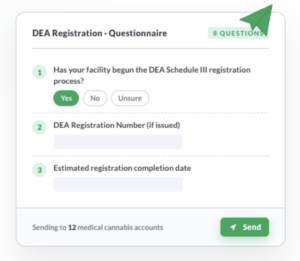
By the time DEA registration officially opened, we had a new questionnaire live in every client’s account. It’s called DEA Registration Status and it serves as a tool to identify which operators are affected (medical and dual-licensed only), tracks each operator’s progress through registration, captures supporting documentation, and flags accounts that may need additional review.
Adult-use only operators are screened out automatically based on their first response, so FIs can deploy the questionnaire across their full portfolio without sorting in advance.
The product team went from “this is happening” to “this is in production” in a matter of days.
How we move that fast
This isn’t an accident. It’s a design choice we made years ago, and it shapes how the product is architected.
A few of the things that make speed possible:
- Configurable surfaces over hardcoded workflows. Our questionnaire framework is built so that new compliance flows can be authored and shipped without a full engineering rebuild. Adding a new questionnaire type, a conditional path, or a document upload requirement is closer to authoring content than writing code.
- A compliance-aware data model. When you build for a high-regulation industry from day one, your product accommodates the kinds of changes that come up. License types, jurisdiction overlays, and document categories are first-class concepts in our system, not afterthoughts.
- Tight feedback loops with our client-facing teams. Our compliance and customer success teams aren’t downstream of Product. They’re embedded in product planning, which means we hear about regulatory shifts the moment they hit our customers’ radar, not after the next quarterly review.
- A team that takes the timeline personally. This is the cultural part, and it’s underrated. Our product engineers know what it costs an FI to be caught flat-footed by a regulatory change. That sense of responsibility shows up in how aggressively we triage and how quickly we ship.
Why this is a product strategy, not just an engineering one
In a high-velocity regulatory environment, the value of a compliance platform is directly tied to how quickly it reflects reality. If our clients have to build manual workarounds every time something changes, the platform isn’t doing its job.
So responsiveness has to be a product feature, not a marketing message. Every architectural decision we make gets weighed against this question: will it speed up or slow down our ability to react? When the answer is slow down, we don’t make it.
What’s next
Cannabis is in a period of structural change. Schedule III is one shift among many that are likely to come. State-level registration regimes, banking guidance updates, and new federal frameworks are all on the horizon.
We can’t predict every move. What we can do is keep building a product that adapts as fast as the industry does, so our clients can spend their time running their compliance programs, not retrofitting their tools.
That’s the bar we hold ourselves to.


