
Building with You, Not Just For You
Introducing the Green Check Innovation Council
At Green Check, we’ve always believed in building alongside our clients.
In practice, that has shown up in a lot of ways over the years. Support conversations, direct outreach, feature requests, feedback loops with our client-facing teams, and regular discussions with the institutions using the platform every day.
That input has always played a meaningful role in how we shape the product. But as we’ve continued to grow, we started asking a different question.
How do we make that collaboration more consistent, more intentional, and more impactful?
That is what led us to create the Green Check Innovation Council.
Why We Started This
Over the last couple of years, we’ve been investing heavily across the platform. Onboarding, reporting, transaction monitoring, portfolio insights to name a few.
As the product has evolved, one thing has become very clear:
It is not about building more. It is about building the right things.
And the only way to do that well is to stay close to the people actually running these programs day to day.
We already talk to clients constantly. What we wanted to do was take that a step further and create a more structured way to bring that input into the product development process earlier, especially when ideas are still flexible and easy to shape.
Now we’re in a position to do that more thoughtfully. Instead of waiting for feedback after something is built, we can bring the right clients into the conversation earlier, ask more targeted questions, and learn in real time as workflows take shape.
That creates a much tighter loop between what we’re hearing and what we’re building, which ultimately leads to better outcomes for everyone.
This isn’t about listening more. It’s about staying close enough to your workflows that we can build the right things, at the right time, in the right way.
What We Are Trying to Do Differently
The goal of the Innovation Council is not to present a roadmap and ask for feedback at the end.
It is to bring clients in earlier, while we are still working through workflows, tradeoffs, and design decisions.
That means looking at concepts before they are fully baked, talking through how things would actually work in real scenarios, and pressure testing assumptions before we build.
It also means creating a tighter loop between feedback and action. Not just collecting input, but connecting it directly to what gets designed, built, and released.
We want to spend less time guessing and more time validating with the people who understand these workflows best.
What We Learned in the First Session
We kicked things off with a small group of financial institutions and walked through a few areas of the product that are actively evolving.
The energy in the session was exactly what we hoped for. Engaged, thoughtful, and very real. People were not just reacting to what we showed, they were building on top of it, challenging assumptions, and bringing their own workflows into the conversation.
Very quickly, the discussion moved beyond individual features and into something broader.
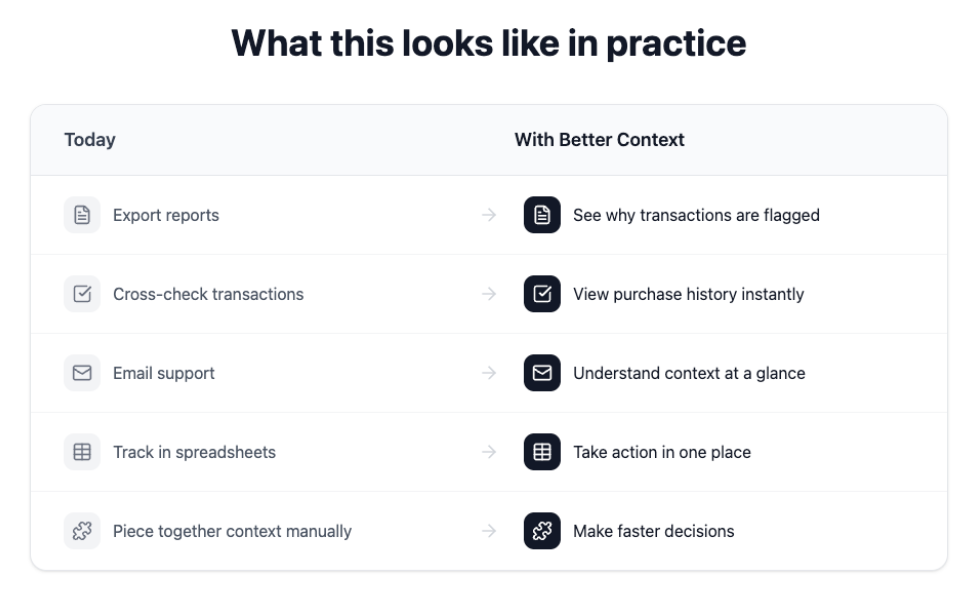
As programs grow, teams are looking for ways to move faster, rely less on manual processes, and have more context directly within the platform.
Teams talked about wanting to answer simple questions about their customers’ sales data without leaving the platform. Things like:
- Why was this transaction flagged for further investigation?
- Has this customer hit a purchase limit across multiple visits?
- Is this an actual issue, or something we’ve already reviewed?
Today, those answers often require pulling reports, cross-referencing data, or reaching out for help.
What we heard clearly is that teams want that context to live right where they’re working, so they can make decisions quickly and confidently without breaking their flow. None of this came across as dissatisfaction. It came across as maturity in their cannabis banking program. These are teams that are scaling, and their expectations are evolving with them.
That is exactly where we want to meet them.
From Features to Workflows
We spent part of the session walking through a few areas of the product that are actively evolving and getting early reactions from the group.
What was most valuable was not just the feedback on specific ideas, but where the conversation naturally went.
It shifted from features to workflows.
- Where are teams still doing work outside the platform?
- What parts of the workflow feel harder than they should?
- Where is more context or visibility needed to make confident decisions?
These are the kinds of signals that are difficult to capture through feature requests alone, or even through individual conversations in isolation.
But when you bring the right group together and give them space to think out loud, patterns emerge quickly.
That is where real product direction comes from.
What Makes This Powerful
The most useful part of the session was not just the feedback itself, it was the context behind it.
Hearing how teams approach their workflows, where things break down, and what they are doing outside the platform gives us a much clearer picture of where we need to focus.
It allows us to move beyond solving for individual requests and start solving for the underlying system.
Combined with the tools we now have, this becomes even more powerful. We can take those insights, validate them through targeted in-app feedback, test solutions with a defined group using feature flags, and iterate quickly before rolling anything out more broadly.
This is what a modern product development loop should look like.
Where This Goes From Here
This is not meant to be a one-time session or a heavy, formal program.
We will continue meeting with the group periodically, but a lot of the interaction will happen in between. Through targeted outreach, in-app prompts, design reviews, and early access to features where it makes sense.
The goal is to make this feel like a natural extension of how we already work with clients, just more structured, more visible, and more connected to how we build.
Over time, this becomes less of a program and more of a system.
The Bottom Line
We’re not trying to build faster just for the sake of it. We’re focused on building in a way that actually reflects how these programs operate day to day.
That’s what the Green Check Innovation Council is really about.
What stood out most from the first session was how quickly the conversation moved beyond the features. It turned into a really thoughtful discussion about how the platform should evolve.
That’s exactly what we hoped for, and exactly how we want to continue building.
If you’re a current Green Check client and interested in getting involved in future sessions, we’d love to hear from you at product@greencheckverified.com.
And if you’d like to follow along as we continue to share insights like this, you can subscribe to our newsletter here or follow us on LinkedIn for regular updates.
We’re excited about where this is going, and even more excited to build it together!


